
01
RESEARCH TWIN
Turn the research processinto a runnable research twin
For a focused research object, ScienceX organizes the question, data, experiment, run evidence, and research decisions into a continuously corresponding digital state. Every cycle can expose its version, compare differences, and return to the next question.
RESEARCH TWIN ≠ VISUALIZATIONA research twin is neither an experiment screenshot nor a flowchart
A useful research twin exists only when the research object, experimental conditions, execution, evidence, and decisions remain traceably aligned and can be run and compared again.
- 01OBJECT
Object layer
Research object, scientific question, observables, and data structure.
→ - 02EXPERIMENT
Experiment layer
Variables, controls, conditions, protocol versions, and acceptance criteria.
→ - 03EXECUTION
Execution layer
Models, algorithms, tools, parameters, environments, and authorization state.
→ - 04EVIDENCE
Evidence layer
Inputs, outputs, logs, sources, hashes, failures, and uncertainty.
→ - 05DECISION
Decision layer
Researcher-approved boundaries, open questions, and next hypotheses.
MINIMUM VIABLE TWIN
Object modelVersioned experimentReplayable runEvidence returnHuman decision
A result without conditions and versions is not a twin. A workflow without replayable evidence is not a twin either.
02
CURRENT TWIN UNIT
Not a concept diagram: an experiment twin that can run, fail, and replay
The HepG2 × SX-101 teaching case generates simulated data locally, then runs a versioned experiment design, deterministic 4PL analysis, technical-evidence evaluation, and replay. It preserves failures and inconclusive evidence as well.
Four reproducible run outcomes
Dose responseCompletes analysis and creates 3 artifacts
Changed dataThe pinned old version still replays
Missing wellFails explicitly without filling values
Weak responseRun completes with inconclusive evidence
Simulated teaching data. It does not establish efficacy, wet-lab validation, or a scientific conclusion.
03
TWIN LOOP
Results return to twin state.Research enters the next cycle.
ScienceX currently provides a researcher-driven digital experiment loop: pin versions, run analyses, preserve technical evidence, and replay comparisons. Only after calibrated real-world sources are connected can experimental feedback update the research twin.
- 01QuestionResearch focus
- 02HypothesisCandidate explanation
- 03EvidenceData and sources
- 04ExperimentExperiment / compute
- 05ResultOutcome and boundary
- 06Next questionContinue the loop
STATE LAYERResearch Memory
Goals · candidate hypotheses · dataset versions · evidence relations · decisions · results · open questions
The current loop is researcher-driven. ScienceX assists execution, recording, and replay; it does not replace the final scientific judgment.
Experiment design → pinned dataset → deterministic analysis → technical evidence → Artifact → Replay
Instrument / ELN / LIMS / human observation → dedicated connection and validation → twin-state update
04
EVIDENCE TO NEXT
Insight is not a random guess.It emerges from differences in evidence.
ScienceX compares versions, conditions, and run outcomes to expose evidence gaps, sensitive variables, and sources of conflict. It produces testable candidate hypotheses and experiment suggestions for researcher review.
Evidence gaps
Find claims that lack controls, replicates, critical conditions, or source support.
Parameter sensitivity
Compare which variable changes are most likely to alter the current result.
Cross-run differences
Trace changes in data, design, parameters, and outcomes across versions.
External conflicts
Locate differences in object, conditions, or measurement between literature and local results.
ILLUSTRATIVE CANDIDATE
SCIENCEX / NEXTAfter a weak response, what should the next cycle test?
- Observation
- The run completed, but the dose response is weak and the technical evidence remains inconclusive.
- Candidate account
- The current concentration range may not cover an identifiable response region.
- Proposed next step
- Extend the concentration range and add replicates and controls around the critical region.
- Required validation
- A researcher reviews the design; only real experiments or independent data can update scientific judgment.
DECISION STATEAwaiting researcher confirmation
A candidate next step is a testable suggestion grounded in technical evidence. It is not autonomous discovery and does not start a real experiment automatically.
05
HOW IT WORKS
How ScienceX carriesone twin run
Models generate candidate reasoning. ScienceX orchestrates authorized tools, records inputs and outputs, and preserves research state; the researcher makes the important judgments.
- 01Understand
Read the question, research thread, and current evidence.
→ - 02Plan
Break down the task and define the next execution path.
→ - 03Act
Call capabilities installed locally and explicitly authorized.
→ - 04Verify
Inspect inputs, results, warnings, and artifacts.
→ - 05Preserve
Save conclusions, boundaries, and next steps after researcher confirmation.
STATE LAYERResearch Memory
Goals · candidate hypotheses · dataset versions · evidence relations · decisions · results · open questions
!Preserving research state does not update model weights automatically, and automated execution is not a scientific conclusion.
06
PRODUCT IN USE
The twin is not just a concept diagram.It runs inside today’s workbench.
Research projects, threads, scheduled tasks, and research Skills carry the twin through daily work. These are cropped, privacy-safe views of the current product.
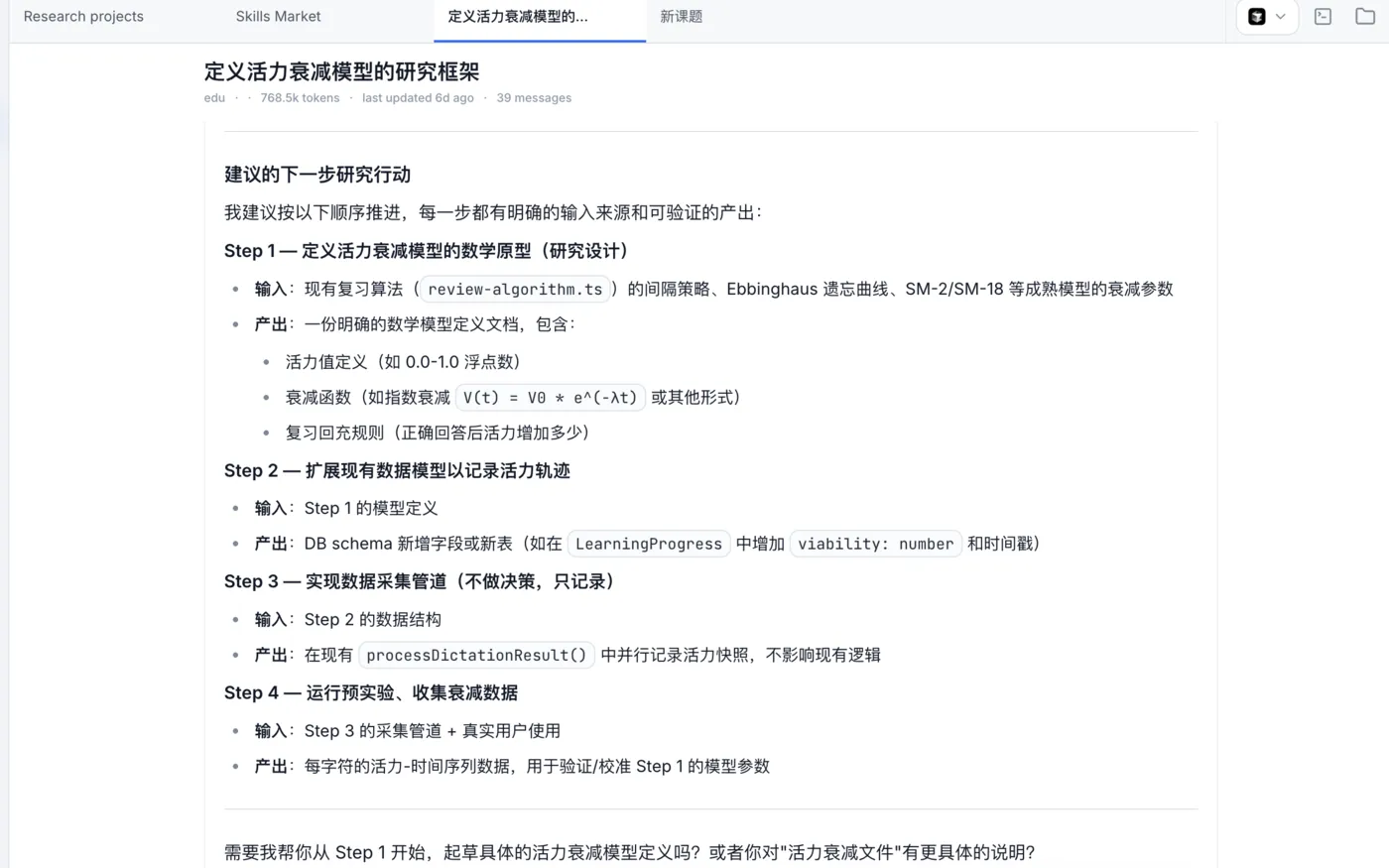
01
A thread carries the question forward
Keep the research question, process notes, files, and proposed actions in one record that can continue.
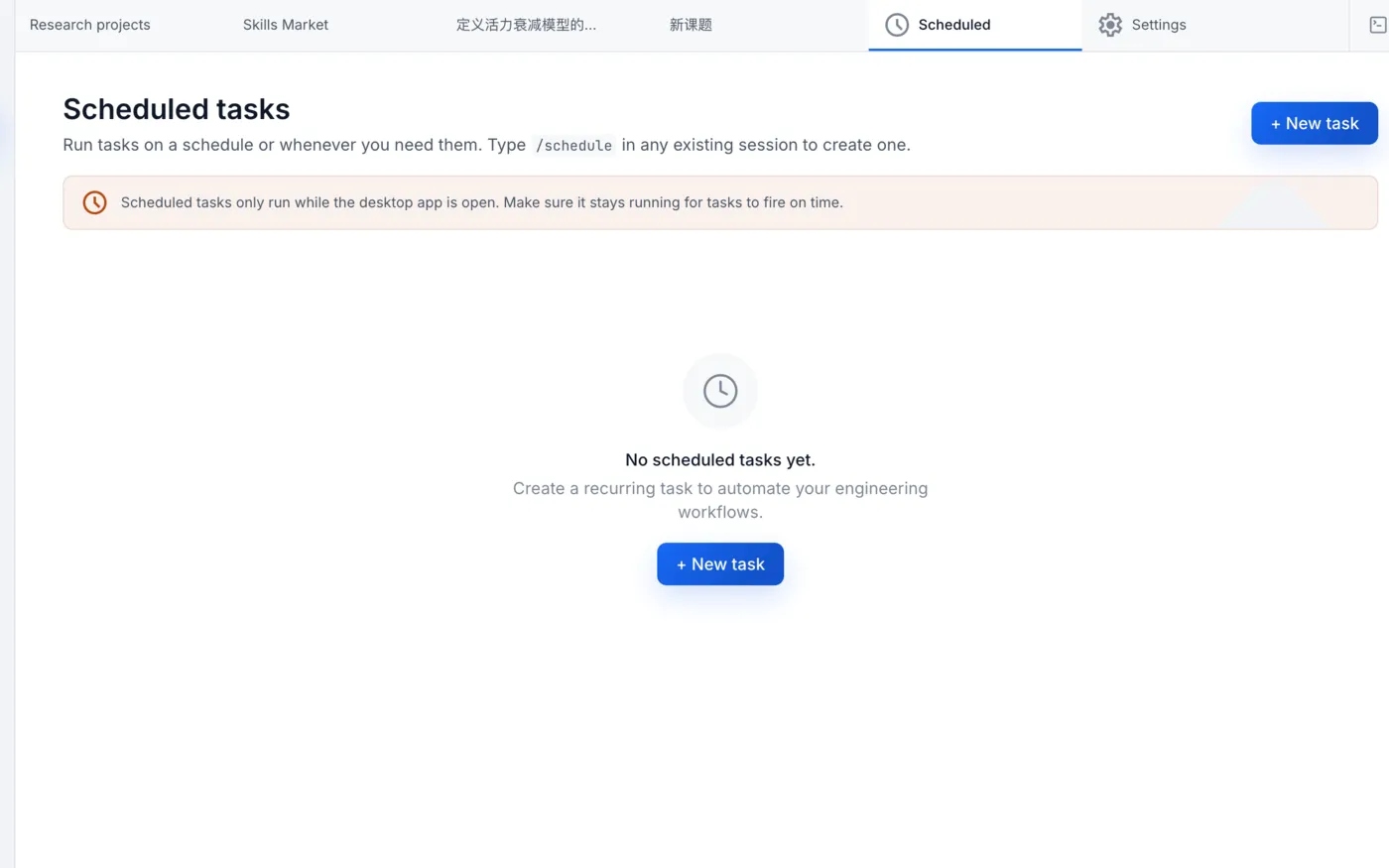
02
Recurring work can run on a schedule
Create and manage scheduled desktop tasks. Local tasks run only while the app is open and the device stays awake.
RESEARCH SKILLS20
Methods are visible capabilities, not hidden prompts
Research Skills appear independently in the product so researchers can inspect their names, sources, and operating boundaries.
ScienceX CAPABILITY INDEX
The interface evolves by release. Actual availability depends on the current release, local dependencies, connection state, and authorization.
07
DAILY RESEARCH
Let daily workkeep the research twin running
Search, organization, review, and expression no longer disappear across disconnected tools. They add evidence, maintain state, and create reviewable artifacts for one research object while researchers retain close reading, judgment, and direction.
01Artifact
Find sources
Search and screen by scope, source, date, and acceptance format.
- Artifact
- A sourced paper table and evidence brief
- Researcher keeps
- What deserves close reading and trust
Example promptFind representative papers on X from the last three years. Cite every item.
02Artifact
Track progress
Organize planned, active, completed, and paused work in the research thread.
- Artifact
- Progress board, review, and next-step list
- Researcher keeps
- Priority and research direction
Example promptSummarize this week, blockers, and the three most important next steps.
03Artifact
Trace logic
Interrogate premises, evidence, counterexamples, and scope one claim at a time.
- Artifact
- Argument gaps and questions to verify
- Researcher keeps
- Answers and changes to the argument
Example promptAct as a rigorous reviewer and ask what makes each claim hold.
04Artifact
Refine expression
Correct, polish, and normalize terms while recording each type of change.
- Artifact
- Suggestions, diffs, and a style record
- Researcher keeps
- Position, conclusion, and personal voice
Example promptShow original, revision, and reason. Do not rewrite my conclusion.
Repetitive work becomes valuable when it updates a shared research state instead of losing context across chats, files, code, and experiment records.
08
RESEARCH SKILLS
20 research Skills.Methods across the twin lifecycle.
Skills help build, run, verify, and update research twins. They are inspectable methods; runtime requirements, external access, and real-instrument connections are never implied.
20research Skills integrated with ScienceX
Read the Skills guide 013
Build the twin
Define the research object, experiment design, and verifiable data baseline.
- /find-science-skills
- /experiment-design
- /research-baseline-builder
023
Add evidence
Find papers, retrieve sources, and build evidence that can be checked.
- /giiisp-paper-search-apis
- /scansci-pdf
- /sci-employee-deep-research
032
Generate candidates
Turn evidence differences into candidate directions and expose gaps through reviewer-style questions.
- /scispark
- /good-question
046
Create research artifacts
Organize papers, figures, slides, videos, and course artifacts.
- /academic-writing
- /scientific-humanization
- /giiisp-scientific-image-generation
- /visual-deck-builder
- /manim-agent
- /practical-course-producer
054
Verify & update
Review papers and citations while preserving researcher-approved long-running state.
- /thesis-audit-reviewer
- /papercheck
- /cognitive-profile
- /world-threads-entry
062
Evaluate & extend
Assess MCP servers and Skills before adopting new tools or connectors.
- /mcp-criticagent
- /skill-criticagent
Execution environments connect after authorizationLocal filesPDF / CSV / project folders Code & terminalRepositories / commands / scripts Model providersConfigured reasoning models MCP servicesEnabled extension tools Data sourcesAuthorized databases and services ComputeExisting local compute capabilities
Integrated does not mean universally runnable. Some Skills require local dependencies, external services, or user authorization. ScienceX has no default access to paper libraries, databases, or other systems.
09
HUMAN IN THE LOOP
ScienceX executes and records.Researchers own judgment and direction.
ScienceX can take on repetitive, reviewable execution. It cannot choose trusted evidence, validate an experiment, or sign off on a scientific conclusion for the researcher. High-risk actions require explicit authorization.
ScienceX
- Search, read, and organize
- Code, compute, and compare
- Execute authorized tools
- Preserve process and candidate hypotheses
Researcher
- Ask important research questions
- Review protocols and critical evidence
- Decide what the results support
- Choose the next research direction
- 01AI assists expression; it does not author the conclusion
- 02AI helps screen; it does not replace close reading
- 03Sensitive data stays within defined boundaries
- 04Technical evidence is not a scientific conclusion
10
CAPABILITY MATURITY
From a digital experiment twin to real-world feedback
The homepage separates product-object maturity from AI-role maturity. A digital experiment twin is validated now; domain structure, real feedback, and multi-path autonomy belong to later stages.
NOWAvailable now
Digital experiment twin
Versioned experiment designs, pinned data, deterministic analysis, technical evidence, artifacts, and replay.
VERSION → RUN → EVIDENCE → REPLAY→NEXTNext stage
Domain research twin
Stable data structures, specialist models, evaluation rules, and sustained research state for a focused domain.
DOMAIN MODEL → CONTROLLED STATE→CONNECTDedicated connection
Real-world feedback twin
Update twin state through validated ELN, LIMS, instrument, or observational-data connectors.
REAL FEEDBACK → VALIDATION → UPDATE→VISIONLong-term vision
Research twin network
Compare multiple candidate research paths in parallel while researchers govern, merge, retain, or stop them.
MULTI-PATH → COMPARE → DECIDEThe current product does not provide generic instrument control, unattended wet-lab operation, or automatic model-weight updates. MCP is an extension seam only.
11 ScienceX / RESEARCH TWIN WORKBENCH
Start with one runnable twin unit
Run the built-in simulated case to understand versions, evidence, and replay. Then define a verifiable digital experiment for your own research object.- 01Run the built-in twin case
- 02Define the research object, variables, and acceptance criteria
- 03Inspect evidence and confirm the candidate next step
Research-object onboarding template
I want to build a research twin around X. The research object is [object], the input data are [format and version], the adjustable variables are [variables], the output metrics are [metrics], and the acceptance criteria are [criteria]. First identify missing conditions, and do not assume a real instrument is connected.